Introduction
Modified Higgs couplings are studied in the κ framework, where modifications of the Higgs-boson
couplings are described by coupling strength modifiers at tree level. The coupling to vector bosons is
modified by κ
V (assuming custodial symmetry, κ
Z = κ
W), the
couplings to fermions by κ
F or by individual modifiers κ
t,
κ
b, κ
c, κ
τ, κ
μ, and the
loop-induced processes by κ
g, κ
γ and κ
Zγ.
In the Standard Model all κ
i = 1. More details are given in the report by the
Higgs boson working group.
Electroweak precision observables (EWPO) constrain the Higgs sector through the virtual contributions
of the Higgs boson to the gauge-boson self-energies. At leading-logarithmic accuracy, a universal
rescaling of the HVV coupling modifies the oblique parameters S and T, with U = 0. This provides a
constraint on κ
V that is
independent of the Higgs signal-strength measurements
and does not require any assumption on the total width. Combining the two gives access to the total
Higgs-boson width and to decays into final states that are not experimentally accessible.
The effective description is not renormalisable by itself, so a cut-off scale is required. We use
Λ = 4πv ≈ 3 TeV as default, the naive-dimensional-analysis estimate of the
strong-coupling scale of the electroweak symmetry-breaking sector, and also quote results for
Λ = 1 TeV. (This scale is written as Λ with a tilde in the figures; the cut-off of the
effective description is Λ
* = Λ / |1 - κ
V2|
1/2.)
The EWPO input is described in the
SM section. The Higgs
signal strengths are taken from the most recent ATLAS and CMS combinations. Full details are given in
our
latest publication.

Constraints on Higgs couplings
Using the general parametrisation, in which all fermion couplings and loop-induced contributions have
independent modifiers, the ATLAS and CMS signal-strength measurements alone give results consistent
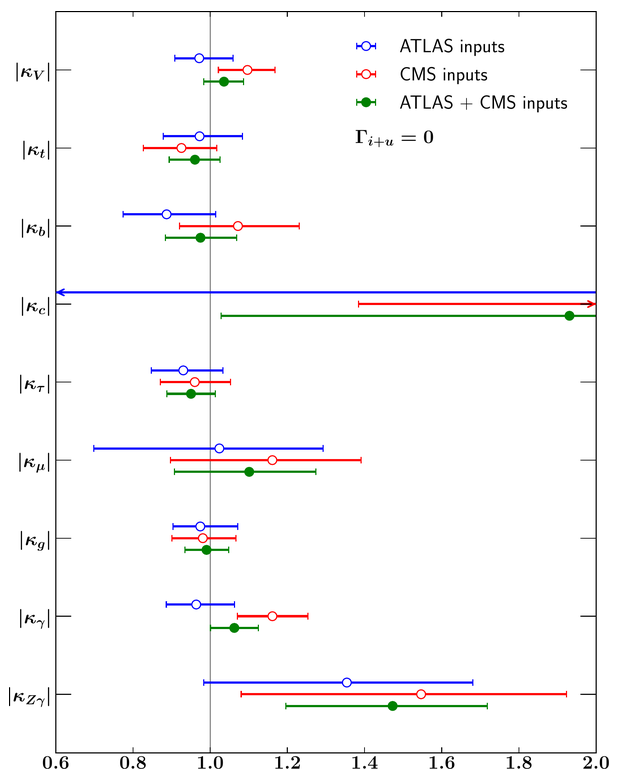
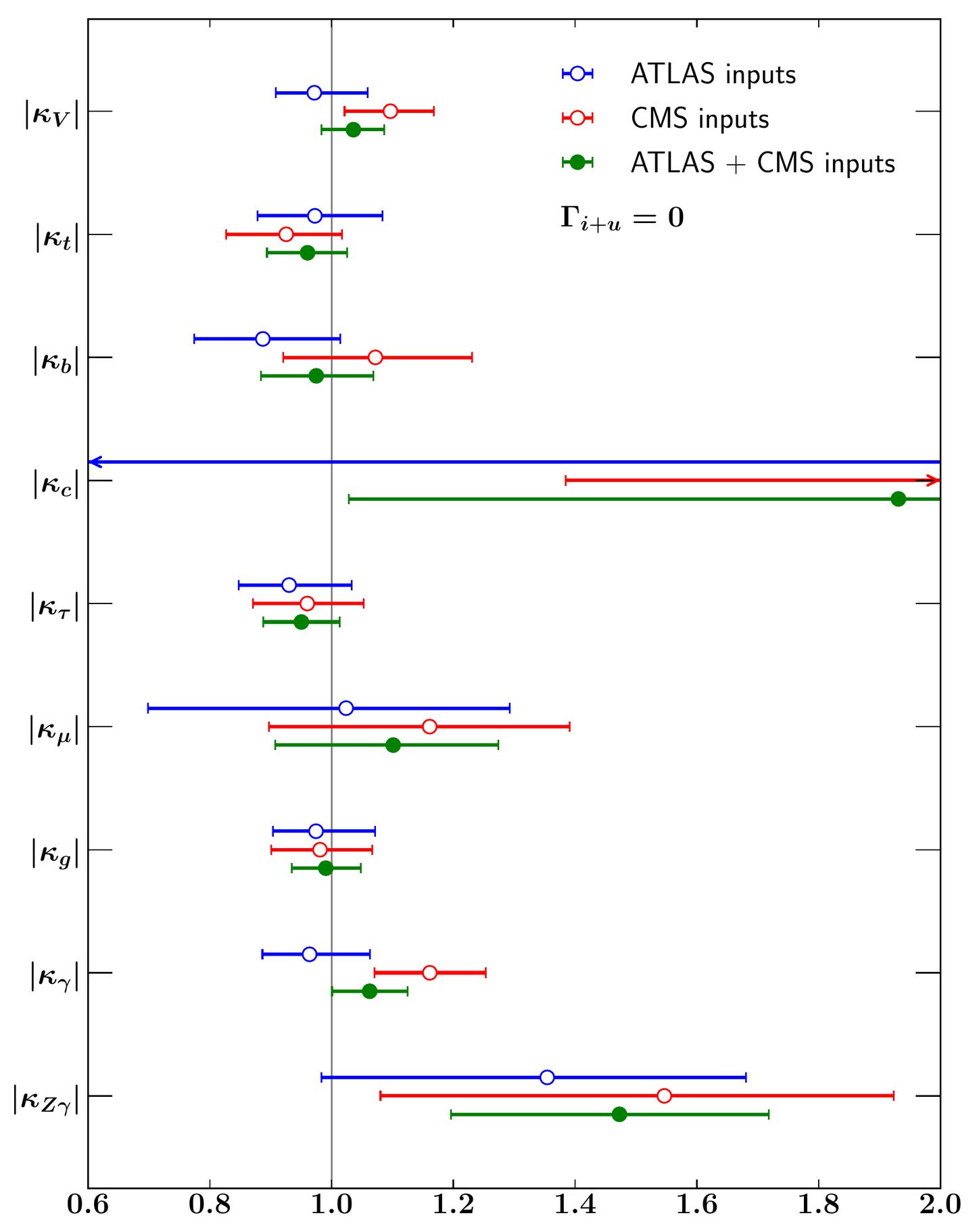
with the Standard Model. For the HVV modifier the combined fit gives
κ
V = 1.035
+0.051-0.053. The largest deviation is found for
κ
Zγ = 1.47
+0.25-0.28, corresponding to about 1.7σ.
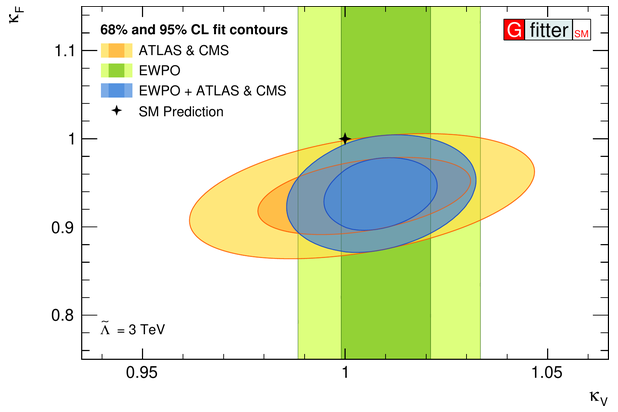
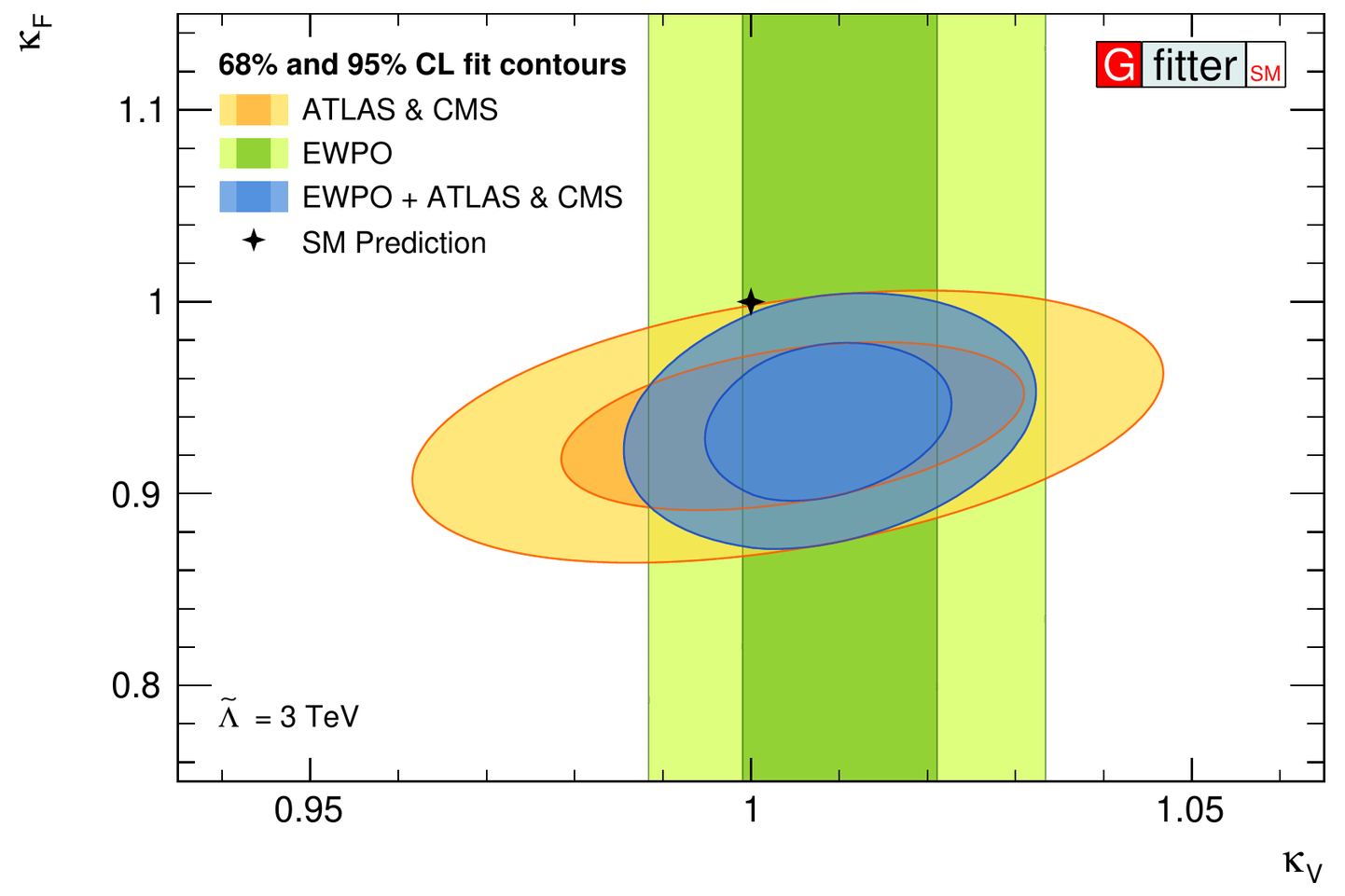
From the EWPO alone, without any Higgs signal-strength input, we obtain
| κV = 1.009+0.012-0.010 for Λ = 3 TeV |
| κV = 1.011+0.017-0.013 for Λ = 1 TeV |
This agrees with the determination from the Higgs signal strengths in the resolved parametrisation,
κ
V = 1.005 ± 0.017, but is more precise, owing to the high experimental and
theoretical precision of the EWPO, and it does not require the assumption of no invisible or
undetected decays.
|
Constraints on the κi modifiers in the general parametrisation, using Higgs
signal-strength measurements from ATLAS (blue), CMS (red) and their combination (green). Since all
κi enter quadratically, only their absolute values are constrained. Arrows indicate
central values outside the plotting range.
|
 .pdf
.pdf
|
|
Constraints in the κV-κF plane from Higgs signal-strength measurements
in the resolved parametrisation (orange), from the EWPO (green), and from their combination (blue).
Fits including EWPO use Λ = 3 TeV. The 68% and 95% contours are computed for one degree of
freedom in the EWPO-only fit, and for two degrees of freedom otherwise.
|
 .pdf
.pdf
|
Total width of the Higgs boson
By providing an independent constraint on κ
V, the EWPO reduce the freedom in the
Higgs-coupling fit and allow a determination of the total Higgs-boson width without specifying a
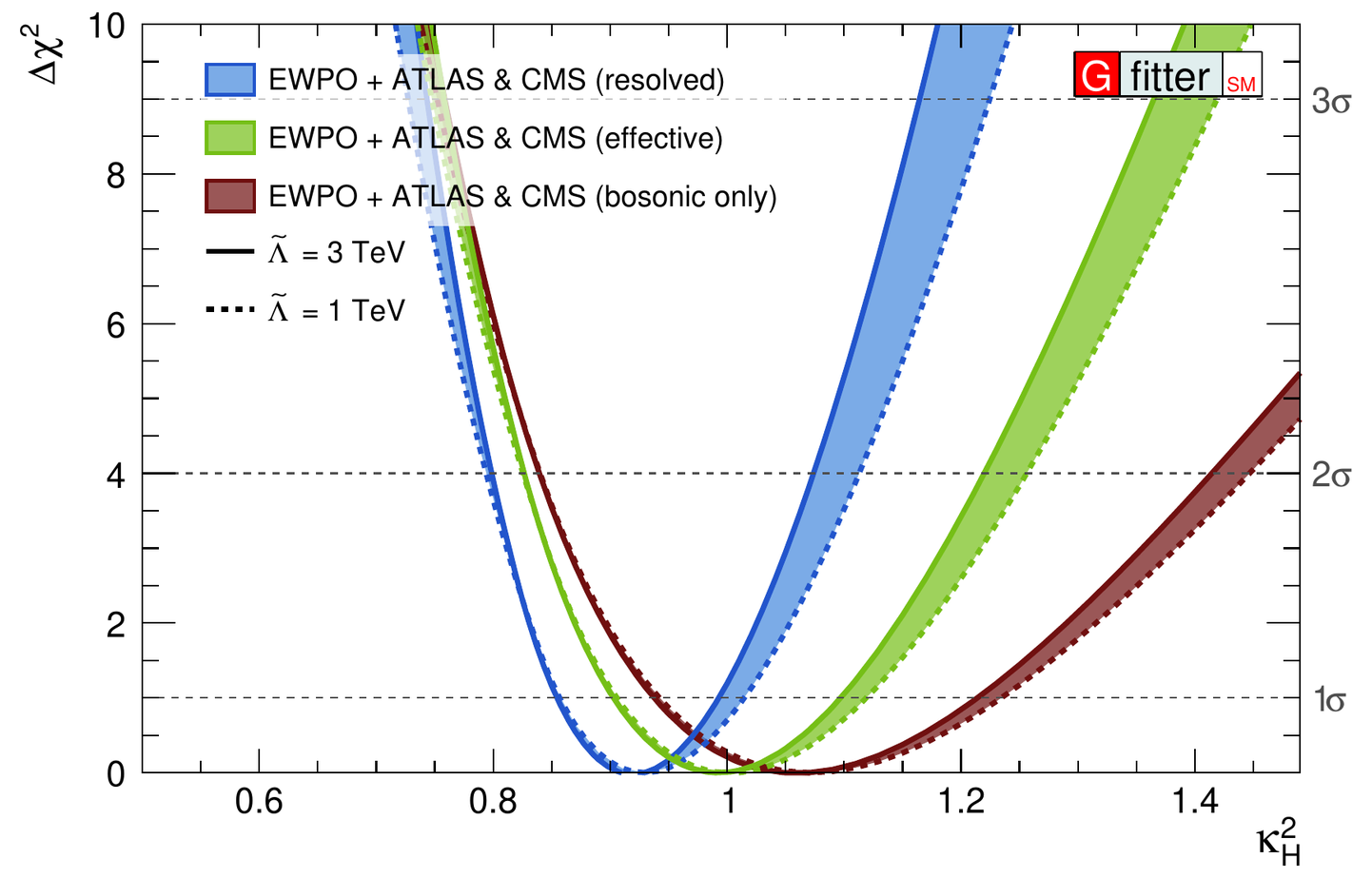
particular extension of the Standard Model. The total-width modifier
κ
H2 = Γ
H,tot / Γ
H,SM is treated as a free
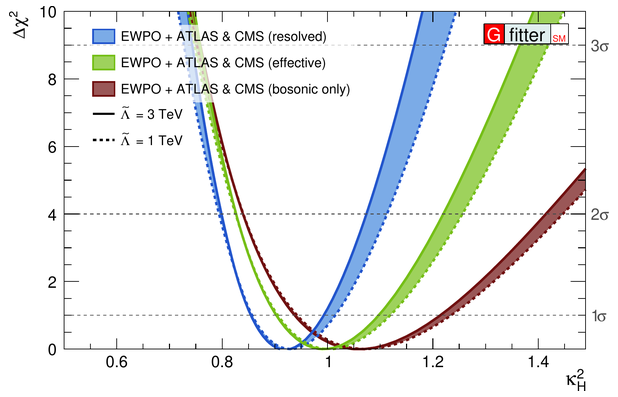
parameter of the fit. The results below are for Λ = 3 TeV.
| bosonic parametrisation (11 signal strengths + 24 EWPO) | ΓH,tot = 4.36+0.63-0.50 MeV |
| effective parametrisation (31 signal strengths + EWPO) | ΓH,tot = 4.08+0.43-0.37 MeV |
| resolved parametrisation (59 signal strengths + EWPO) | ΓH,tot = 3.78+0.30-0.27 MeV |
These values are to be compared with the SM prediction Γ
H,SM = 4.10 ± 0.06 MeV.
Including more
signal-strength information tightens the constraint, at the cost of stronger assumptions on the
Higgs-boson couplings. The effective and resolved parametrisations determine the total width with a
relative precision of about 10% or better.
Reducing Λ from 3 TeV to 1 TeV shifts the central values by
-0.04 MeV, independently of the parametrisation, and increases the uncertainties by about 5%, 10% and
15% for the bosonic, effective and resolved parametrisations, respectively.
|
Scans of Δχ2 versus the total-width modifier κH2 for
the different parametrisations. Solid and dashed lines correspond to Λ = 3 TeV and 1 TeV,
respectively.
|
 .pdf
.pdf
|
Invisible and undetected branching fraction
Higgs-boson decays into final states that are not experimentally accessible at the LHC enter the total
width through
Γ
H,tot = Γ
H(κ) / (1 - B
inv - B
undet),
where B
inv and B
undet are the invisible and undetected branching fractions. The
total-width constraint from the combined EWPO and signal-strength fit therefore translates directly
into a constraint on B
i+u = B
inv + B
undet. In this formulation
B
i+u is determined from the data and does not rely on the SM prediction for the total width,
nor on direct searches for invisible Higgs decays.
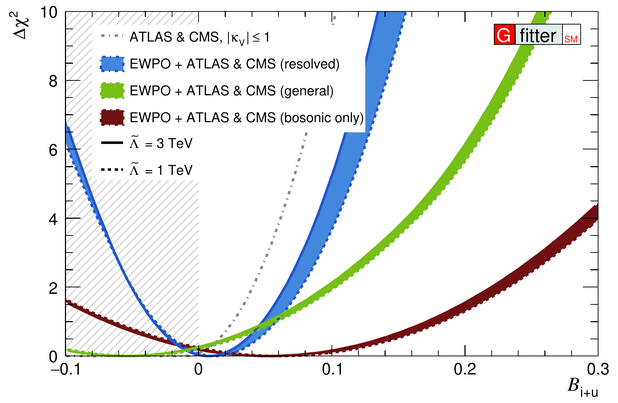
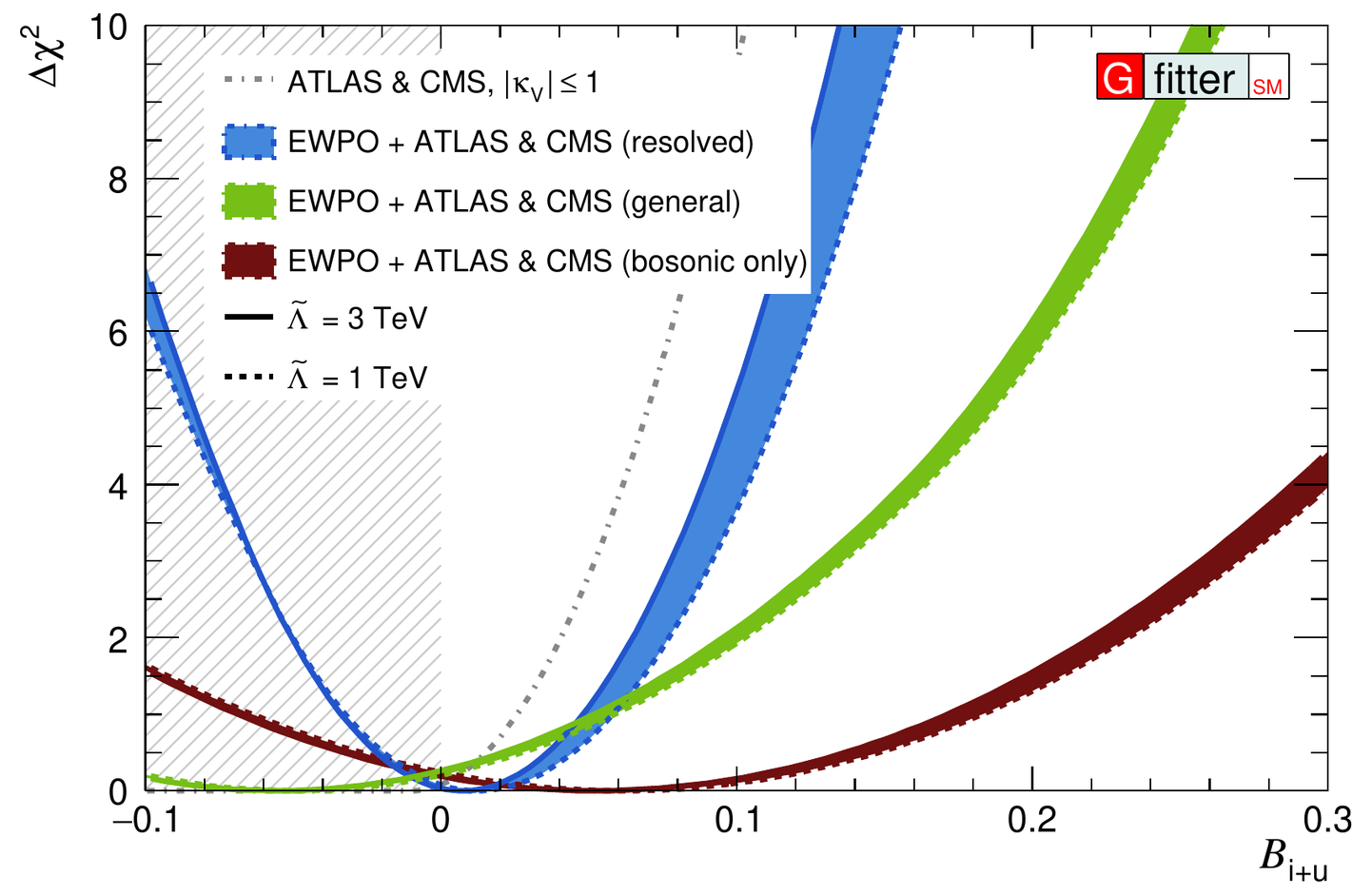
The limits below are at 95% CL, obtained by integrating the likelihood over the physical region
B
i+u > 0, for Λ = 3 TeV. Expected limits are given in parentheses.
| bosonic parametrisation | Bi+u < 0.27 (0.23 expected) |
| general parametrisation | Bi+u < 0.17 (0.16 expected) |
| resolved parametrisation | Bi+u < 0.09 (0.08 expected) |
In the bosonic parametrisation only the HVV coupling is modified, and all other coupling modifiers,
most notably the fermionic ones, are set to their SM values. In the general parametrisation
B
i+u is fitted together with all κ
i modifiers, so that no assumption on any
coupling modifier is needed. The resolved parametrisation gives the tightest bound, owing to its
stronger assumptions on the fermion couplings and the loop-induced processes.
None of these bounds rely on the assumption |κ
V| ≤ 1, which is commonly used when
only signal-strength measurements are available. Imposing that assumption with signal strengths alone
gives B
i+u < 0.07 at 95% CL.
|
Scans of Δχ2 versus Bi+u = Binv + Bundet from the
combined fit to EWPO and Higgs signal strengths, for the different parametrisations. Solid and dashed
lines correspond to Λ = 3 TeV and 1 TeV, respectively. The signal-strength-only result with
|κV| ≤ 1 is shown for comparison.
|
 .pdf
.pdf
|
Assumptions and caveats
The constraints on κ
V, Γ
H,tot and B
i+u given above rely on
a restricted effective interpretation, and the following assumptions should be kept in mind:
- The EWPO enter only through the leading-logarithmic contribution of a universal HVV
rescaling to the oblique parameters S and T, with U = 0.
- The SM loop structure is otherwise unchanged, custodial symmetry is unbroken, and there are no
BSM effects beyond oblique corrections. Modified fermion couplings, vertex corrections and direct loop
contributions from new states to the EWPO are not included.
- A rescaled HVV coupling alone is not a complete renormalisable theory, so the cut-off dependence
should be regarded as a leading-logarithmic estimate. A systematic effective-field-theory treatment
would require the relevant operators, counterterms and short-distance assumptions.
- Beyond the one-loop approximation, additional cut-off-sensitive contributions may arise unless
they are suppressed or cancelled by the UV completion.
- The quoted results assume Λ = 3 TeV unless stated otherwise; the dependence on this choice
is quantified above.
The bounds therefore apply to this specific effective description rather than to a general BSM scenario.
 .pdf
.pdf
 .pdf
.pdf
 .pdf
.pdf
 .pdf
.pdf