Introduction
Oblique parameters are designed to
constraint models of new physics from the electroweak precision observables. It is assumed that the effects of new physics only appear
through vacuum polarisation and therefore lead to modified oblique parameters.
Most of the effects on electroweak precision observables can be parametrised by three
gauge self-energy parameters (S, T, U) introduced by Peskin and Takeuchi
[Phys.Rev.D46, 381-409(1992)].
- T measures the difference between the new physics contributions of neutral and charged current processes at low energies (i.e., sensitive to isospin violation).
- S (S+U) describes new physics contributions to neutral (charged) current processes at different energy scales.
- U is only constrained by the W boson mass and its total width. In addition, U is generally small in new physics models. Therefore, the STU parameter space can often be projected down to a two-dimensional parameter space in which the experimental constraints are easy to visualise.
The STU parameters shown here have been obtained with all inputs described in our
latest publication, including NNLO calculations for all observables
(except Γ
W).

Determination of the oblique parameters
The constraints on the STU parameters are derived from a fit to the electroweak precision data, more details can be found in the
SM section.
Besides the STU parameters the floating fit parameters are
M
Z=91.1879±0.0020 GeV,
Δα
had(M
Z2)= 0.02758±0.00009,
and α
s(M
Z2)=0.1177±0.0009.
The following fit results are determined from a fit for a reference Standard Model with m
t,ref=172.5 GeV and M
H,ref=125 GeV:
| S = 0.03 ± 0.10 | |
| T = 0.05 ± 0.12 | |
| U = -0.03 ± 0.09 | |
The correlation coefficients between the STU parameters are given by
|
S |
T |
U |
| S |
1 |
0.92 |
-0.67 |
| T |
|
1 |
-0.88 |
| U |
|
|
1 |
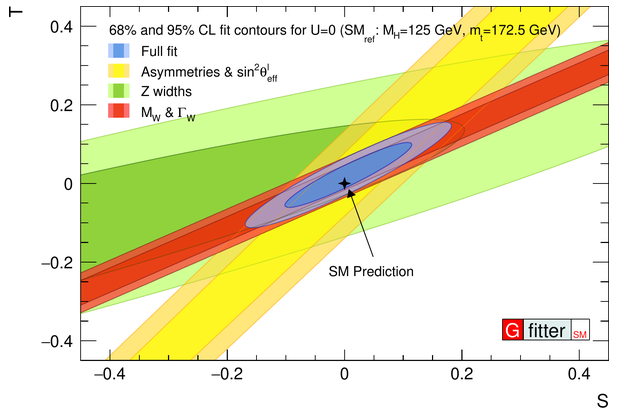
When fixing U=0, the fit gives S|
U=0 = 0.01 ± 0.07 and T|
U=0 = 0.02 ± 0.05,
with a correlation of +0.94. Owing to the new measurements of M
W and
sin
2θ
effl, the central values are closer to the SM expectation and the
uncertainties are reduced with respect to our previous analysis.
|
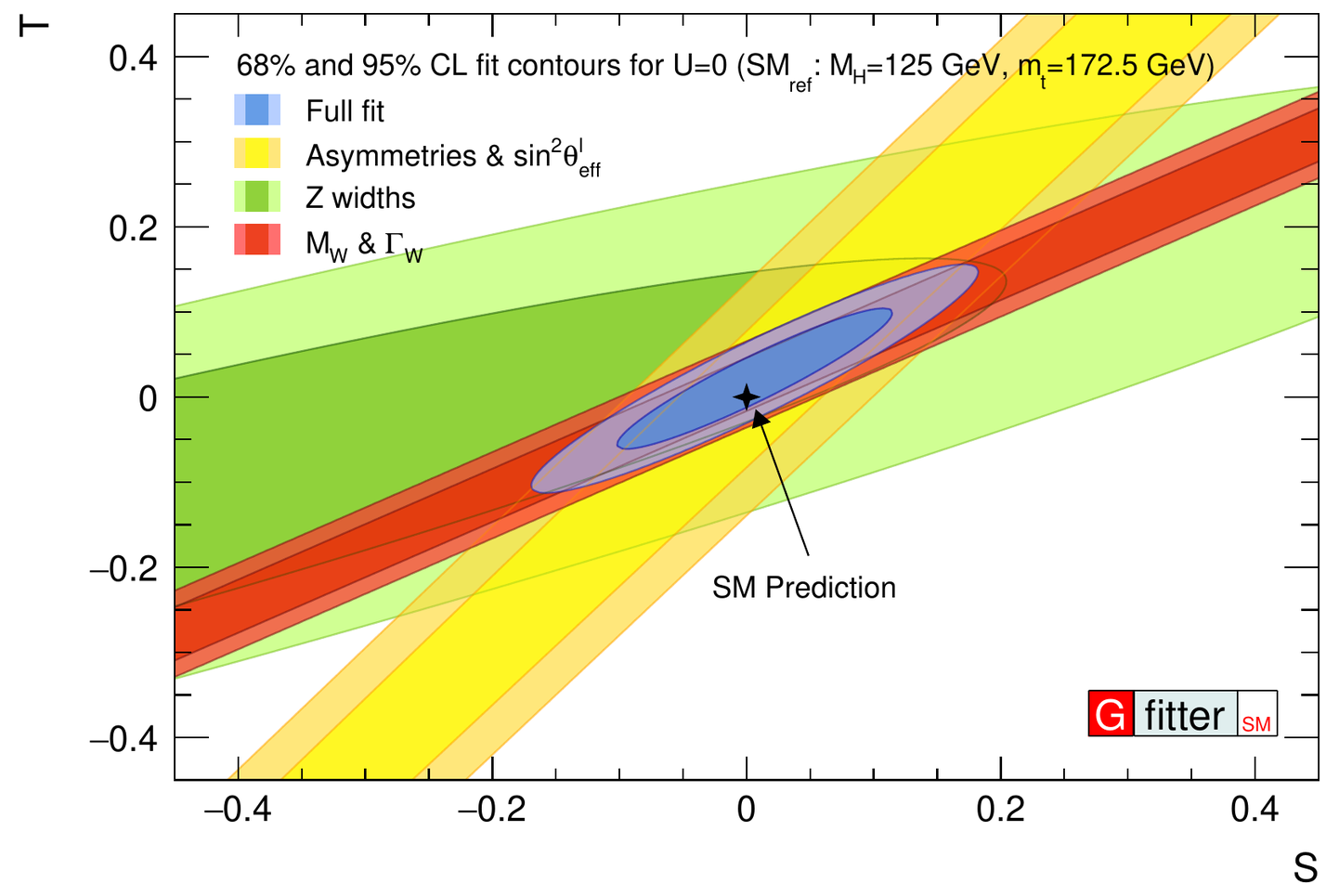
Constraints on the oblique parameters S and T, with U fixed to zero. The combined constraint from
all observables is shown in blue. Individual constraints are shown for the asymmetry and direct
sin2θeffl measurements (yellow), the Z partial and total widths (green),
and the W mass and width (red), with confidence levels drawn for one degree of freedom.
The reference point at which all oblique parameters vanish is defined by
MH,ref=125 GeV and mt,ref=172.5 GeV.
|
 .pdf
.pdf
|
Testing new physics models with oblique parameters
Oblique parameters can be used to confront BSM models with constraints from electroweak precision measurements.
Models which have been investigated by the Gfitter group are
- Inert Higgs and littlest Higgs models
- Models with large, universal or warped extra dimensions
- A fourth fermion generation
- Technicolour
- The Two-Higgs-Doublet-Model
A detailed description of the analysis together with constraints on these models can be found in the Gfitter publication
Updated Status of the Global Electroweak Fit and Constraints on New Physics.
 .pdf
.pdf